The admissions files / 1838–1840 and 1874–1875
Less Fruit, More Cake: Two Boarding-School Girls Write Home
A Pennsylvania seminary pupil in 1838 and the future founder of the Girl Scouts in 1874 both wrote home from school. Their parents wanted news and got requests.
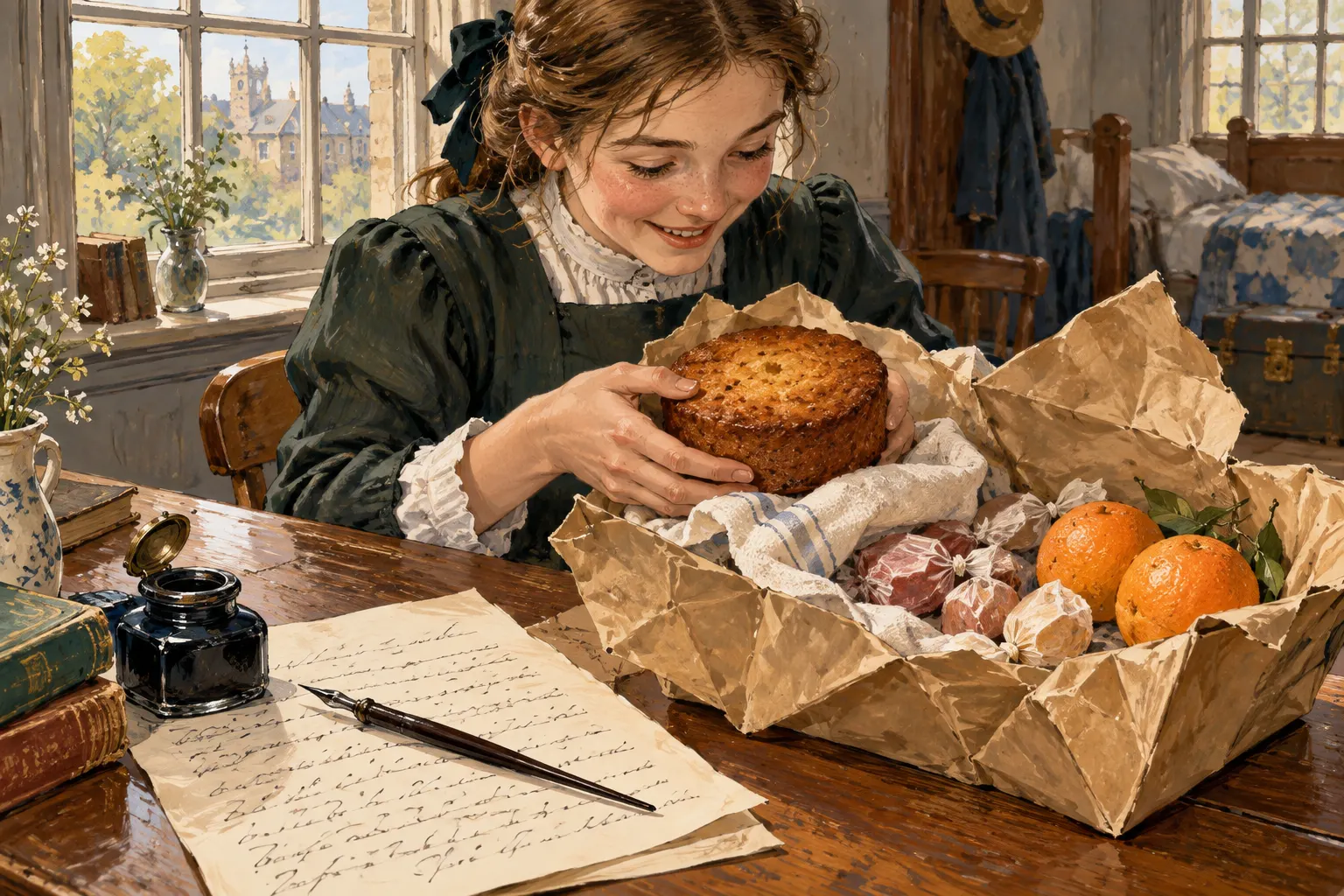
Between August 1838 and February 1840 a pupil at the Bethlehem Female Seminary in Pennsylvania wrote twenty-four letters home, and the Clements Library, which keeps them, has summarized their position on care packages. Less fruit. More cake and candy. She was specific. She supplied lists.
Our eldest went to a three-week summer program last year. We sent a box with granola bars, a card from the youngest and two clementines. We received one text: "pls no clementines."
What the Bethlehem letters supplied less of was news. Then, in February 1840, the seminary's principal asked her parents to take her home, citing repeated disobedience. The letters home, the library notes, had given no sign of it. They had been about cake.
A generation later Juliette Gordon Low, known as Daisy, the future founder of the Girl Scouts, was writing home from boarding school to her mother, and the Georgia Historical Society has published the letters. October 1874: thanks for the box of candy and the dress.
February 1875: a warning that letters might be infrequent, because "I hate to get ready to write," though once she starts she doesn't mind. A question about a tooth with a hole in it: should she have it filled or not? A request for more of the little elastics for her hair, as the ones sent are all used up. Signed, with a parenthesis: "(I have not grown a bit,)"
March 1875: her mother has just visited. She is lonely. She has not cried once. She will be very good and study hard. She would like a reply soon, it is ten weeks until they meet, and then a postscript that every parent will recognize as a request for applause: "aint this a nice letter, not one mistake in spelling."
There is a mistake in that sentence, and I have counted it many times, with love.
Then, in 1878, she sent her mother an account of how she had spent $10. Shoes, $7.00. Drawing paper, 25 cents. A T tray, a triangle, India silk, a metallic pen, and a 20-cent fare for two, leaving 5 cents in change. It balances.
Mine never balance. The eldest got $60 for the summer program and accounted for it in one line, "food lol," which is the 2025 equivalent of no mistakes in spelling.
We sent a second box. No clementines. Cake, as instructed. She texted back within the hour, which has never happened before or since: "omg." Then, a minute later: "could u send more."
Sources
The public records, school pages and published accounts this story draws on. Where the story imagines a scene or a line of dialogue, that is the column’s telling, not a quotation.
- Barbara DeWolfe, Clements Library: Velvet Ribbons and Oyster Pie, The Quarto, spring 2000, pages 4–5 clements.umich.edu
- Georgia Historical Society: Juliette Gordon Low — Early Life, original Gordon Family Papers letters georgiahistory.com
- Moravian Academy: Our History moravianacademy.org