The admissions files / One January week in a farming township, in the years of boarding round
When the Teacher Boarded at Your House for a Week
In the nineteenth century, rural teachers often "boarded round," living a week at a time with their pupils' families. The memoirs remember cold rooms, hot arguments and jealous children.
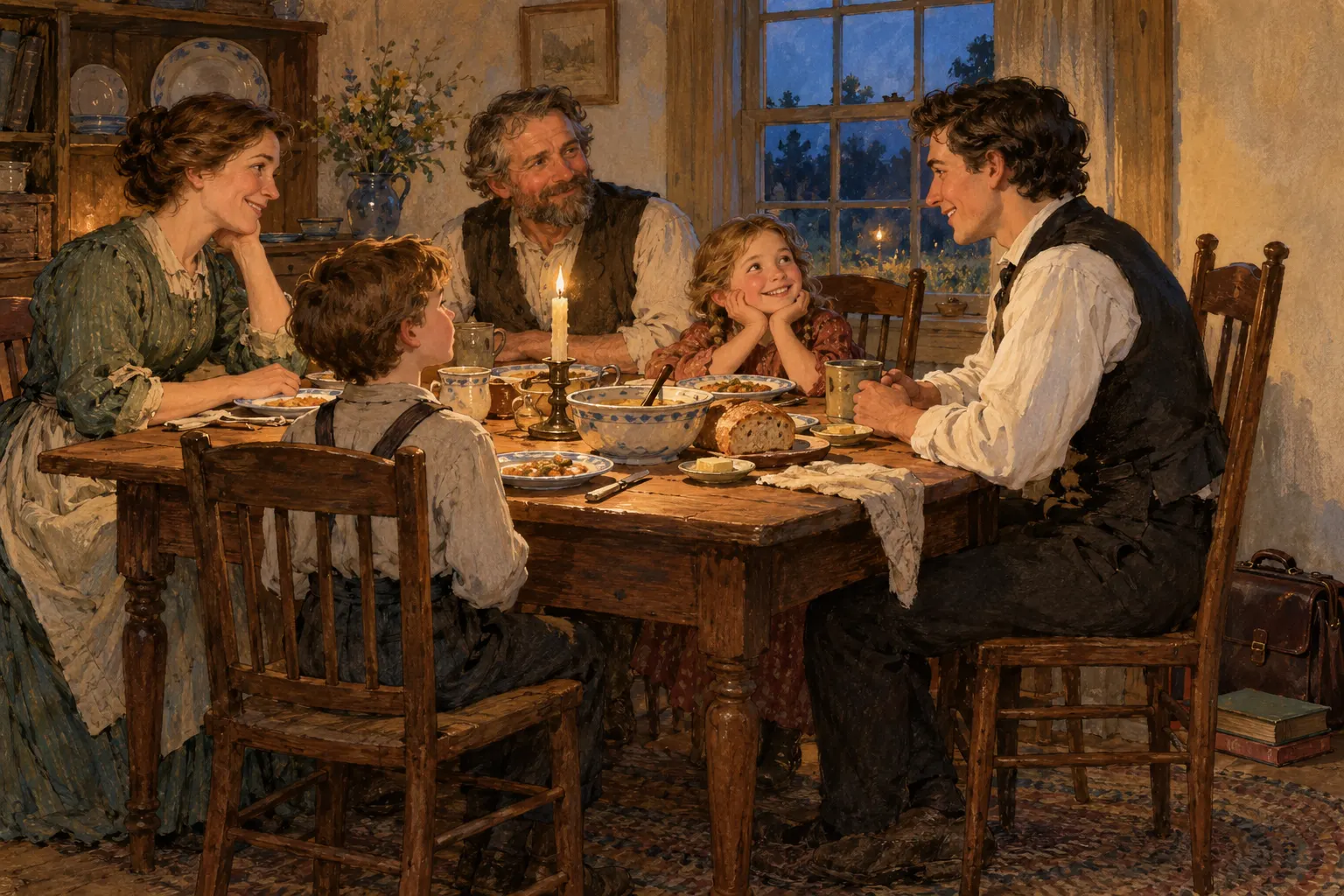
For much of the nineteenth century, an American country teacher often came with a housing problem. Towns that wanted an educated teacher had to provide room and board. More often than not, the essayist Michael Day writes for the Country School Association of America, the teacher "boarded round": lived with pupils' families, often moving every week. It helped the teacher get to know the families, and it saved the town money.
Not every arrangement was kind. In one literary account, a schoolmaster complained of being "at noonday publicly sold at auction" to the lowest bidder for his keep. A Wisconsin teacher wrote in 1851 that some weeks her room was so open that snow blew in and landed on her bed, and in it.
It was common. Connecticut's Board of Education counted, in 1846, 911 teachers boarding round and 174 boarding themselves.
Sylvester Barbour, writing his reminiscences of Canton, Connecticut, in 1908, remembered boarding round during his first three terms. The hospitality was warm. In one house, he and his host, a Democrat, argued politics pleasantly every night; Barbour was a Whig. The spare room in winter had no fire and the sheets were cold, and lying there he found himself wondering whether the person who had last slept in that bed was still alive. He admitted the fear was his own.
The schoolmaster who kept thirty children in order lay awake in a farmhouse, nervous about a bed.
In Indiana, a 1917 township history printed a letter from a former pupil, E. J. Cox, remembering his teacher, Mary Ann Taylor, who stayed a week at each house. The children, he recalled, were jealous of the time she spent at other homes.
Jealous. Not relieved that the teacher had left. Jealous that the neighbors had her.
The teacher at your table, every night, for a week, and then at the neighbors'. That is a parent-teacher conference with no end time.
The youngest has invited her teacher to dinner four times this year. The teacher has, wisely, declined each time. So the youngest has started bringing the teacher home in another form: every evening she sits at the table and tells us exactly what her teacher said today, in her teacher's voice. My wife has asked if the teacher could please board somewhere else next week.
The youngest says the next family is the dog.
Sources
The public records, school pages and published accounts this story draws on. Where the story imagines a scene or a line of dialogue, that is the column’s telling, not a quotation.
- Michael Day, Boarding Round, republished by the Country School Association of America (2024) countryschoolassociation.org
- Sylvester Barbour, Reminiscences (1908), p.26 cga.ct.gov
- Edgar Baldwin, The Making of a Township (1917), Mary A. Morrow’s reminiscence pp.192–194 and Eli J. Cox’s letter p.374 archive.org