The admissions files / September 1937
In 1937, Chicago Held School on the Radio
Polio kept Chicago's schools closed that September, so 315,000 elementary pupils attended by radio. The station magazine noted they could finally throw paper wads at the teacher.
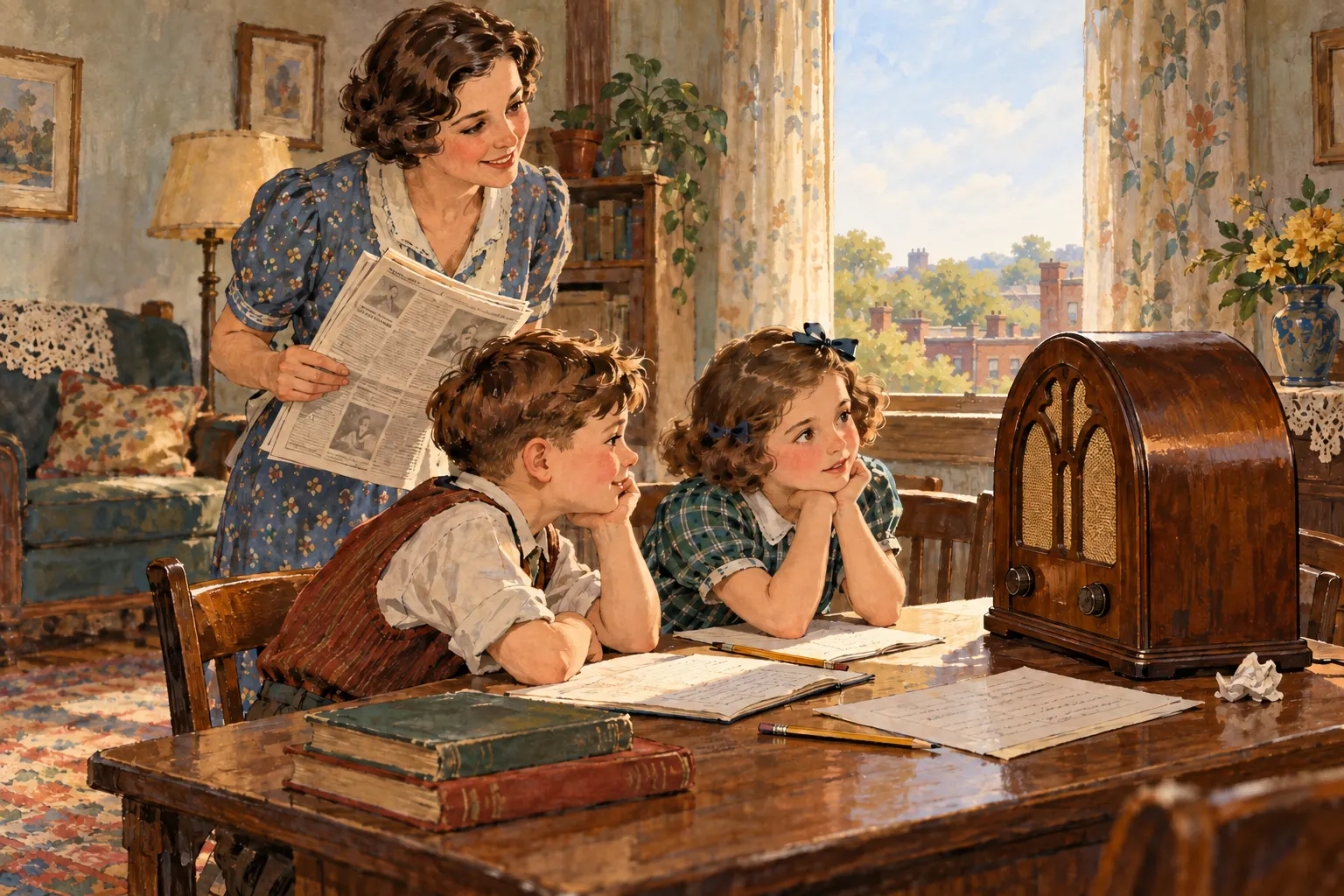
On the Thursday before school was due to open in September 1937, Chicago announced that public and parochial schools would stay closed indefinitely because of infantile paralysis, polio. A radio executive at WLS offered the Board of Education free airtime. Within twenty-four hours, the station's magazine reported, a radio school was underway. Five other stations joined.
At 7:15 a.m. on Monday, September 13, the opening day, class was called to order on the air with the singing of "School Days."
The buildings were empty and the children were in their kitchens, and somebody still insisted on starting with the school song. I respect it.
Newspapers printed each day's lesson text a day in advance. Children in grades three through eight studied it, then heard a teacher explain it in a broadcast, generally fifteen minutes long. High schoolers were expected to study on their own. A staff of about twenty-five teachers stood by to answer questions from parents.
A former state PTA president went on the air to urge mothers to listen in, so they could discuss the lessons with their children afterward. An assistant superintendent urged proper conditions for concentration at home.
Proper conditions for concentration at home. In 1937. With a radio in the living room. I would like to see that home.
The historian Michael Hines, of Stanford, has described what went wrong. Parents called when they could not pick up a station and their child missed a lesson, or when a speaker gave the directions too fast. Some families had several radios, for children in different grades. Some had none, and the schools had to make up work for them. There was a guest star: the explorer Carveth Wells was scheduled to address the third and fourth graders.
The station magazine ended its report on a cheerful note. The children, it said, were allowed to chew gum in class and throw paper wads at the loudspeaker, opportunities they probably would not have again any time soon.
For the first time in history, the teacher could be switched off, and the child knew it.
In the spring of 2020 the eldest was in fourth grade and the middle one was in kindergarten, both on screens at our kitchen table, and the youngest was one and loud. We had one good laptop. The middle one muted his teacher twice to ask me for crackers. The eldest put a sticky note over her camera and did her math under the table with the dog.
Nobody threw paper wads. I did catch the middle one throwing a cracker at the screen. He said it was for the teacher, because she looked hungry.
Sources
The public records, school pages and published accounts this story draws on. Where the story imagines a scene or a line of dialogue, that is the column’s telling, not a quotation.
- Stand By: Radio and the Three R’s, 1937, printed pages 3 and 15 worldradiohistory.com
- Hal Tate: Chicago Stations Supply Radio Lessons, Broadcasting, September 15, 1937, page 24 worldradiohistory.com
- Stanford School’s In: Unprecedented school closures? Not entirely, Michael Hines interview, April 13, 2020 ed-prod.stanford.edu