The admissions files / Late nineteenth and early twentieth centuries
Monday Morning, Answer 'Present' or Hand Over a Penny
A century ago, American schools ran savings banks. A 1914 federal bulletin explained the roll call, the bank book and what the penny was being saved from.
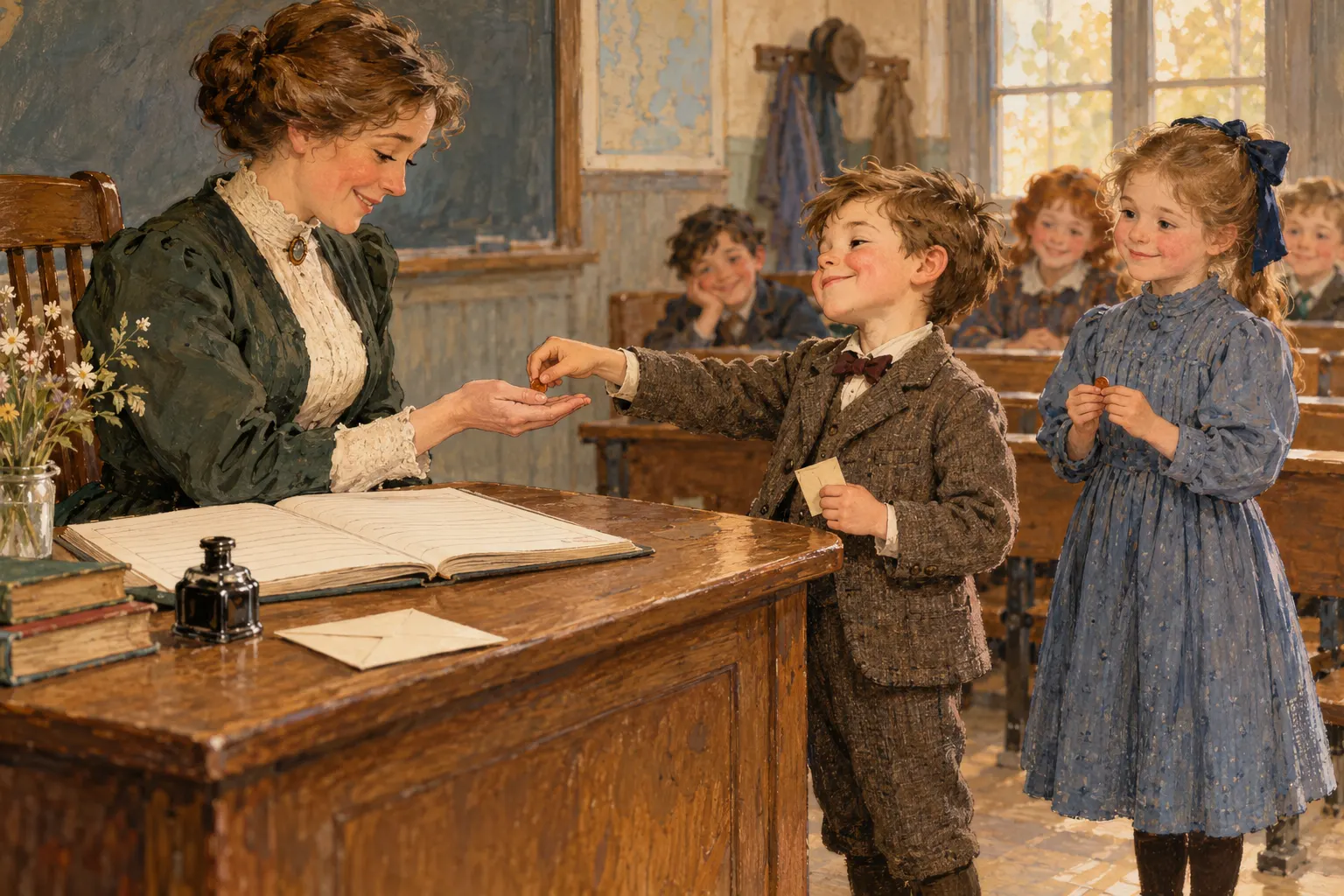
In 1914 the U.S. Bureau of Education published a bulletin on school savings banks, prepared by Sara Louisa Oberholtzer, a Pennsylvania writer who had campaigned for them for years. It explained how a school should run one.
On Monday morning the teacher calls the roll. Each child answers with a deposit, "Yes, 5 cents," or whatever the amount is. The teacher marks it on a small savings card in the child's name, and the child keeps the card as a receipt. A child with nothing to deposit simply says, "Present."
I love that "Present" survives. You came to school. That counted. The penny was extra.
Deposits of one cent or more were accepted. At one dollar, the child got a bank book and became, through the school, a customer of a real savings bank. At three to five dollars, depending on the bank, the money drew interest. The whole thing, the bulletin promised, took the teacher no more than fifteen minutes a week after the first morning.
Deposits were voluntary. But the bulletin was clear what the pennies were being saved from. They were to be planted in a bank as the seed of future fortune, instead of being spent, as often happened, in a candy or cigarette shop, where they could produce only "an extravagance of taste, which ripens into nothingness, intemperance, and poverty."
So the penny was not just saved. It was rescued, from a candy shop, on its way to ruin.
Children had other plans. A Germantown, Philadelphia, memoir published online by the Independence Hall Association remembers banking at school at one and a half percent with the Philadelphia Saving Fund Society, which had thousands of depositors in schools. It also remembers, years later, an iron box of nickels saved at home, a pinball machine plugged in at the candy store, and one afternoon: "I had an iron box full of liberty nickels and lost all in one afternoon to the machine that wouldn't let me win."
The bulletin had warned about the candy store. It had no idea.
The youngest has a piggy bank shaped like a frog. Every Monday, by her own rule, she puts in a coin, and then announces "Present." On weeks she has no coin she says "Present" anyway, and taps the frog. The middle one has started charging her a penny to borrow his markers. She has paid him seven cents so far, all from the frog.
It is the first time I have seen money in this house actually move toward a savings plan, and it was his.
Sources
The public records, school pages and published accounts this story draws on. Where the story imagines a scene or a line of dialogue, that is the column’s telling, not a quotation.
- Sara Louisa Oberholtzer: School Savings Banks, U.S. Bureau of Education Bulletin 1914 No. 46, printed 1915, pages 21–22 files.eric.ed.gov
- Historical Society of Pennsylvania: What Chester County native was an ardent supporter of school savings banks? January 20, 2013 hsp.org
- The Tompkins Diary: Economics 101, Independence Hall Association ushistory.org