The admissions files / One winter weekend at a kitchen counter, with two old kindergarten guides
The First Kindergartens Built Houses Out of Sticks and Peas
Froebel's original kindergarten activities included building frames with pointed sticks and soaked dried peas. An 1898 guide gives the schedule: twelve hours of soaking. We tried it on a weekend.
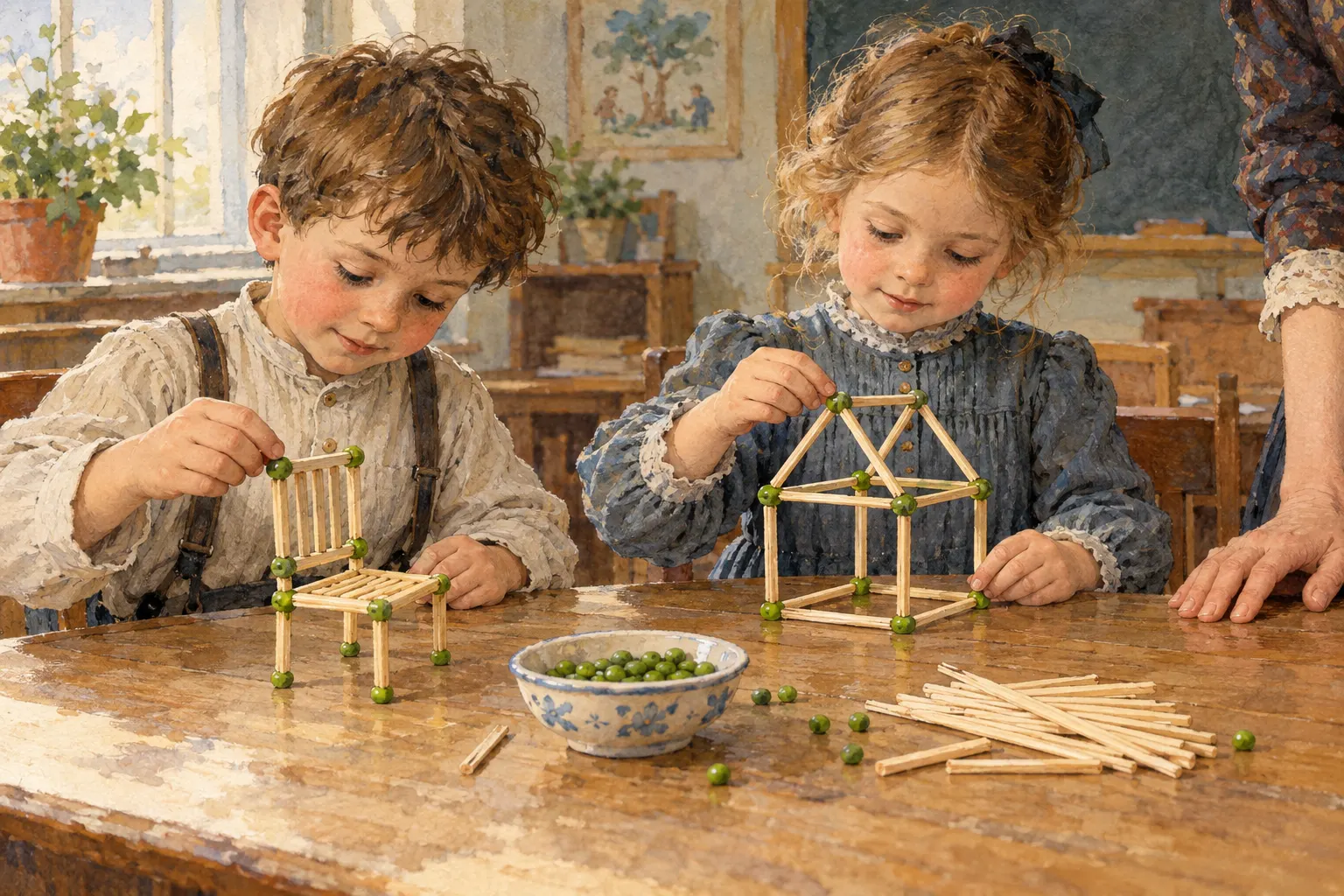
Sticks and peas were one of Friedrich Froebel's original "occupations," the hands-on activities at the heart of the first kindergartens. Children joined small sticks with peas to make lines, shapes and three-dimensional frames. The Froebel Trust in Britain still describes the activity today, noting that it builds fine motor skills and resembles making molecular models.
In 1863, Elizabeth Peabody's American kindergarten guide described the kit: wooden sticks pointed at both ends, and dried peas softened by soaking. With them children could build the frame of a chair, a house or other shapes. The teacher was first to ask the children what they could make, to learn their own ideas.
An 1898 Kindergarten Guide by Lois Bates gave the schedule. Soak the peas for twelve hours, then dry them for one. She also considered the alternatives. Corks were more expensive and broke after a few punctures. Wire bent. And neither made a model as pretty.
Kindergarten had an overnight stage. The teachers of 1898 were thinking about Tuesday's lesson at supper on Monday, which is more forethought than I manage for a lunchbox.
The modern Trust adds that clay, Blu-Tack, plasticine or cork can stand in for peas, and that it is more ethical nowadays to avoid using food for play.
We did not see that sentence until afterward.
On a Saturday morning I announced to the youngest that we would build the 1863 way. She asked what that meant. I said peas. She went back to her cartoon. That evening I put a bowl of dried peas to soak on the windowsill. She asked when we would build. I said tomorrow. She looked at me the way you look at someone who has promised you a dog and handed you a leash.
On Sunday the peas were soft. We dried them on a towel for an hour. I handed her a pile of toothpicks and asked, as Peabody instructs, what she could make. She made a chair in four minutes. It stood up straight. I made a table in twenty. It leaned. She fixed it with one finger, and said nothing, which was worse.
Overnight, the peas dried and shrank and gripped the toothpicks like clamps. By Monday morning, the chair could be dropped from a height. I know, because the dog knocked it off the counter. It bounced.
The youngest asked if we could soak more peas tonight, for tomorrow. She was planning a day ahead. I have never been prouder of a vegetable.
Sources
The public records, school pages and published accounts this story draws on. Where the story imagines a scene or a line of dialogue, that is the column’s telling, not a quotation.
- Mary Mann and Elizabeth P. Peabody, Moral Culture of Infancy, and Kindergarten Guide (1863), Kindergarten Guide pp.43–44 tile.loc.gov
- Lois Bates, Kindergarten Guide (1898), pp.169–171 archive.org
- Froebel Trust: Sticks and peas froebel.org.uk