The admissions files / A children’s school farm, DeWitt Clinton Park, around 1909
In 1902, Hell's Kitchen Children Got Farms With Their Own Broadway
Fannie Griscom Parsons started a children's farm on Manhattan's West Side, four feet by eight per child. The rules were printed in the Parks Department's annual report, and the first rule was about the tag.
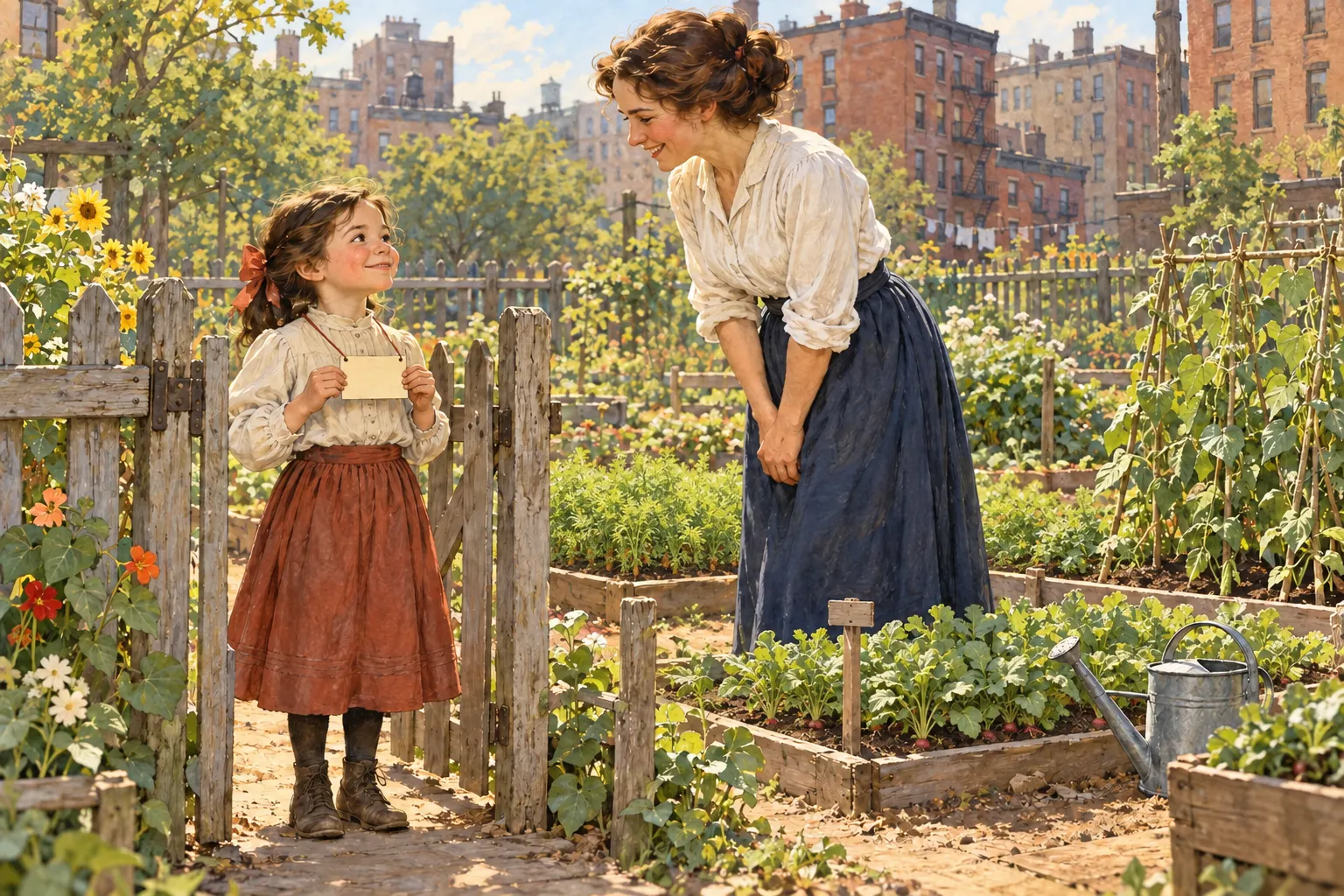
In 1902, Fannie Griscom Parsons started a children's school farm on land in Hell's Kitchen destined to become DeWitt Clinton Park, between the factories, warehouses and tenements of Manhattan's West Side. She said she had not started it simply to grow a few vegetables and flowers. The farm was laid out like a city. It was divided into four boroughs. The main path was called Broadway. The children elected a government to run it.
By 1913, the Parks Department's annual report said, more than 4,000 children had plots across the city's school farms. Each child's plot was four feet by eight. Registration was announced on a blackboard, with separate days for boys and girls. At registration, each child received a tag with a plot number.
The rules followed. "If you lose your tag, you lose your plot." "No one admitted without a tag."
I have been to airports with gentler policies.
A 1910 book by her son, Henry Griscom Parsons, describes the tag: name and address on one side, garden and plot number on the other, hung around the neck on a strong string. It also notes that during the planting demonstration, adults were specially warned to stay quiet.
Adults were warned to stay quiet. Some things about school have not changed in 116 years.
Each child kept the narrow paths around their own plot, and all of them shared the upkeep of the wide paths. And you were not to help on anyone else's plot unless the person in charge of it asked you to.
That last rule should be printed on every kitchen table in America. Do not help with someone else's plot unless asked. I have broken it at every homework session I have ever attended.
The project, as Parsons saw it, was about process, not produce. The farm would teach brotherhood, cooperation, self-respect and the dignity of labor, and turn the children, many of them immigrants, into citizens.
The youngest has a plot this year, in the corner of our yard, roughly four feet by eight. She has a tag, which she made, with her name on one side and "CARROTS" on the other. She wears it to the garden. Last Saturday I offered to help her weed.
She looked at my tag. I did not have one. I was not admitted.
Sources
The public records, school pages and published accounts this story draws on. Where the story imagines a scene or a line of dialogue, that is the column’s telling, not a quotation.
- New York City Department of Parks, Annual Report 1913: Bureau of Children’s School Farms, pp. 173–178 nyc.gov
- The Cultural Landscape Foundation: Frances Griscom Parsons and New York’s Children’s Garden Movement tclf.org
- Henry Griscom Parsons, Children’s Gardens for Pleasure, Health and Education (1910), pp.86–91 and175–176 archive.org