The admissions files / 2013–2015
The $65 Kindergarten Test That Cost Us $600
In 2014 Horace Mann and Riverdale swapped a $568 exam for a $65 iPad test. My eldest was four, and I had a calculator.
In September 2013 the Observer ran an editorial headlined "Good Riddance, E.R.B.", which is the only time I have seen a newspaper throw a party for a four-year-old's exam. Subjecting four-year-olds to it, the paper said, "may not meet the accepted definition of insanity. But it's pretty darn close."
My eldest was three. I read the editorial twice, put the test-prep folder in a drawer and told my wife we were free. She asked free to do what. I said lunch.
By March 2014 the Independent Schools Admissions Association of Greater New York, nearly 140 schools, had told its members they could decide for themselves whether to keep requiring the $568 test. Horace Mann kept it, calling the score "the only piece of the application that is consistent and objective." Léman Manhattan made it optional. One consultant predicted families would sit it anyway, so no school would assume a missing score meant a bad one.
I took the folder back out of the drawer. Optional, in our house, has always meant mandatory with extra steps.
Then the good news. That July, Horace Mann and Riverdale announced they would use a new test, the AABL, taken on an iPad and first given that October. It would cost $65. Under the old test, the founder of a prep company explained, a child who said a mouse was "animal" got one point, and the examiner replied, "Tell me more." My eldest would have told them more. About the mouse in our kitchen. For the full fifty minutes.
A saving of $503, before anyone had found the child's shoes. The same prep company had started one-on-one AABL tutoring a month earlier, at $140 to $200 a session. Three sessions at the top rate is $600. I did the subtraction twice. The first time was exciting.
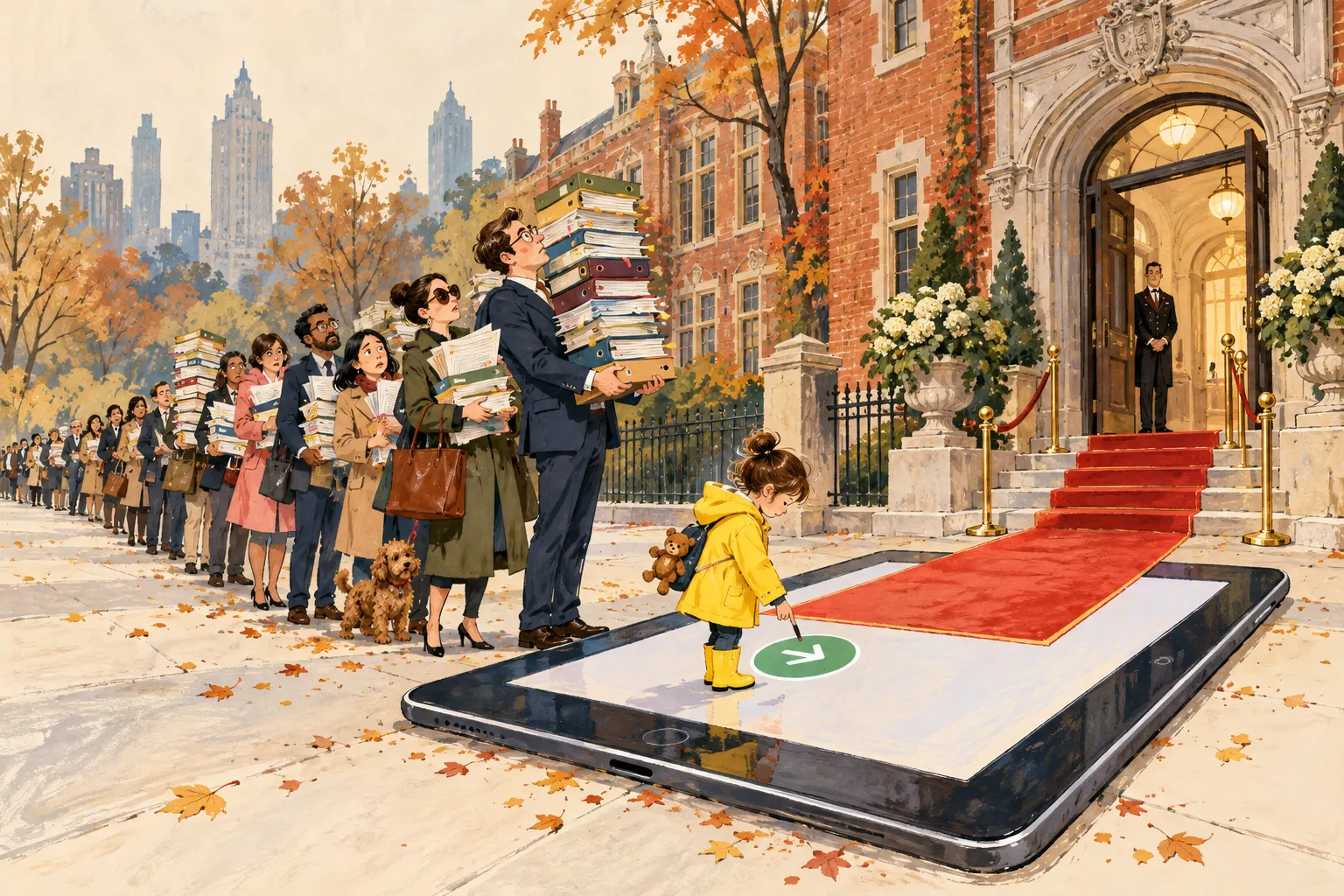
The test's own guide asked for one modest thing: get familiar with the demonstration. Tap orange to hear the question again. Use the white arrow in the green circle to continue. We were familiar by Thursday. By Sunday the middle one, aged six months, could find the green circle, and I was reading the guide aloud at bedtime because it was the only book in the house nobody had a strong opinion about.
In June 2015 Bright Kids announced a tablet-based AABL diagnostic, with its own tablets, headphones and a proctor, to give children "even more of an upper hand on testing day." A rehearsal for the test that replaced the test that was dropped for being rehearsed.
The folder is still in the drawer. It belongs to the eldest now: she is a junior, and it holds her SAT prep. We still haven't had lunch.
Sources
The public records, school pages and published accounts this story draws on. Where the story imagines a scene or a line of dialogue, that is the column’s telling, not a quotation.
- Observer editorial: ‘Good Riddance, E.R.B.’ (September 2013) observer.com
- Amy Zimmer, DNAinfo: optional testing and continuing preparation (March 31, 2014) dnainfo.com
- Amy Zimmer, DNAinfo: the new iPad admissions test (July 7, 2014) dnainfo.com
- Emily Glickman, Abacus Guide: the first reaction (September 21, 2013) abacusguide.com
- Joyce Szuflita, NYC School Help: what families faced (July 23, 2014) nycschoolhelp.com
- ERB: AABL What to Expect Guide, 2014 copyright (PDF) armadeiacademy.com
- Emily Glickman, Abacus Guide: ‘NYC Kindergarten Testing: It’s Complicated’ (September 5, 2014) abacusguide.com
- Bright Kids NYC: AABL diagnostic launch announcement (June 11, 2015) prweb.com