The admissions files / Novgorod, around 1240–1260, and a kitchen table last Tuesday
Onfim Did His Letters, Then Drew a Horse
Around 1250, a boy in Novgorod practiced the alphabet on birch bark and then filled the rest with a horseman. My seven-year-old's homework sheet came home this week with the same layout.
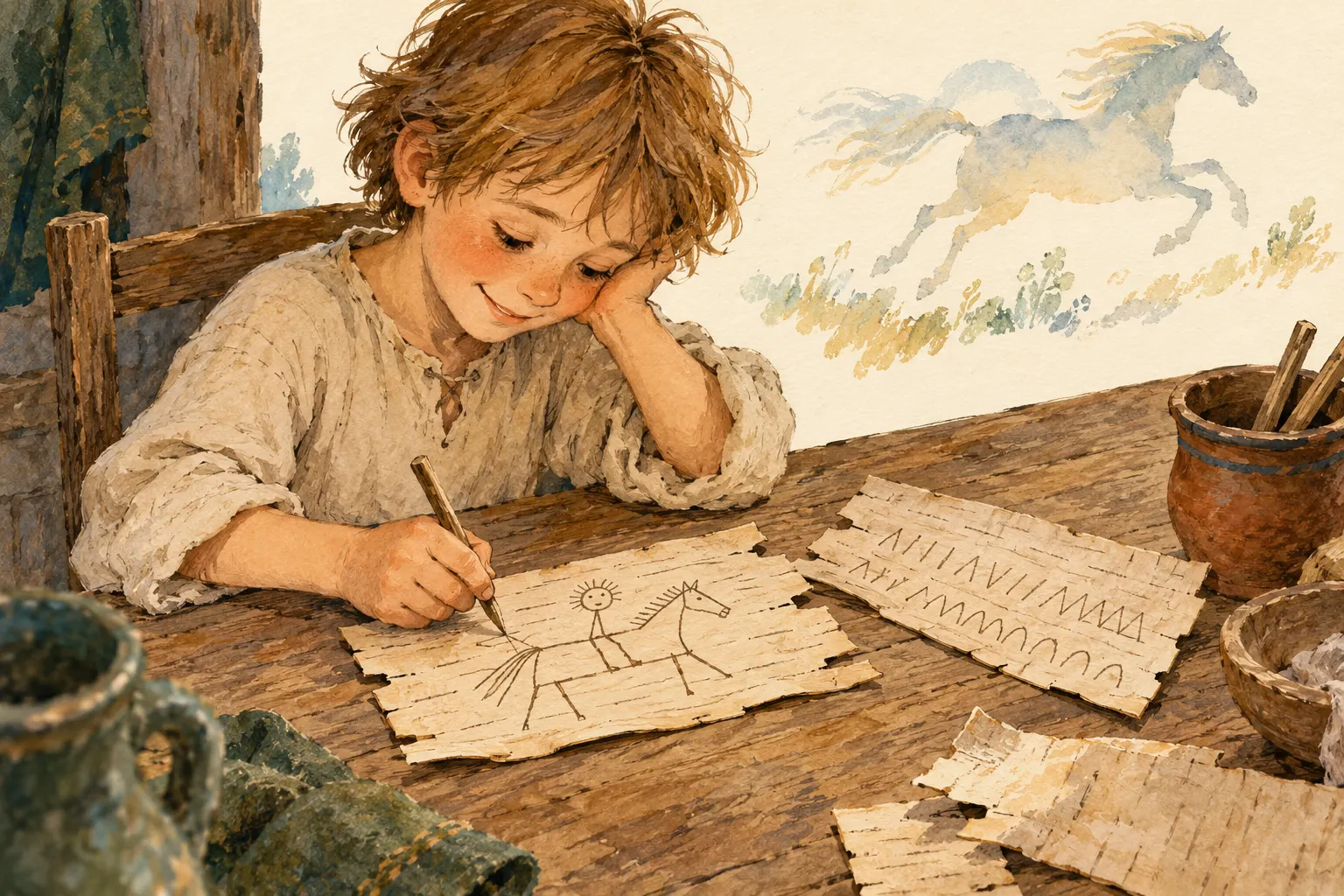
In 1956 archaeologists in Novgorod, in what is now Russia, dug up a set of birch-bark sheets scratched with a stylus by a boy named Onfim. The State Historical Museum in Moscow dates them to roughly 1240 to 1260 and guesses, from the drawings, that he was six or seven. Most of them are school exercises: alphabets, and syllables of the kind children have always chanted, ba, va, ga, da.
In his spare minutes after lessons, the museum says, Onfim drew. Warriors in helmets and cloaks. Battle scenes. Arrows in flight. The museum calls these among the most ancient children's drawings anyone has.
On the piece catalogued as document 200, the alphabet, from a to k, is squeezed into two rows in the upper right corner. The rest of the bark is a horseman striking down an enemy with a spear. Next to him, in case anyone was unclear on the casting, is the name Onfim.
Do the letters. Then, while the grown-up is in the kitchen, add cavalry.
Document 199 is more complicated. On the inside, the full alphabet and rows of syllable drills. On the outside, in a frame, according to the scholarly catalog's translation, a greeting: a bow from Onfim to Danilo. And below it, a drawing of a four-legged animal with a long neck and a curled tail, captioned, in the same translation, "I am a beast."
I have no idea who Danilo was. I hope he wrote back.
The youngest is seven, and in second grade, and this week she brought home a handwriting sheet. Rows of lowercase letters, a through m, in the lines provided. She did a through f carefully, with her tongue out. When I came back from the kitchen, the letters g through m were crammed into the top right corner and the rest of the page was a horse.
The horse had a rider. The rider was holding what was either a sword or a baguette. Beside it she had written her own name, in capitals, with the S backward.
I showed her a photo of Onfim's horseman on my phone. She studied it like a professional. "His horse has a longer neck," she said, and then, kindly, "but mine has a sandwich."
She took the sheet back to school. Her teacher wrote "Great letters!" at the top and drew a small star next to the horse. I am keeping both, for the museum.
Sources
The public records, school pages and published accounts this story draws on. Where the story imagines a scene or a line of dialogue, that is the column’s telling, not a quotation.
- Gramoty: Novgorod document 200, original object, transcription and English translation gramoty.ru
- Gramoty: Novgorod document 199, original document tracing, transcription and English translation gramoty.ru
- State Historical Museum: Onfim’s Birch bark manuscript, horseman defeating an enemy nav.shm.ru