The admissions files / A railway siding in northern Ontario, winter 1952
Ontario's School Came by Train, Stayed a Week, Left Homework
From 1926 to 1967, northern Ontario ran schools on railcars. The teacher's family lived in the back, and the homework stayed behind for a month.
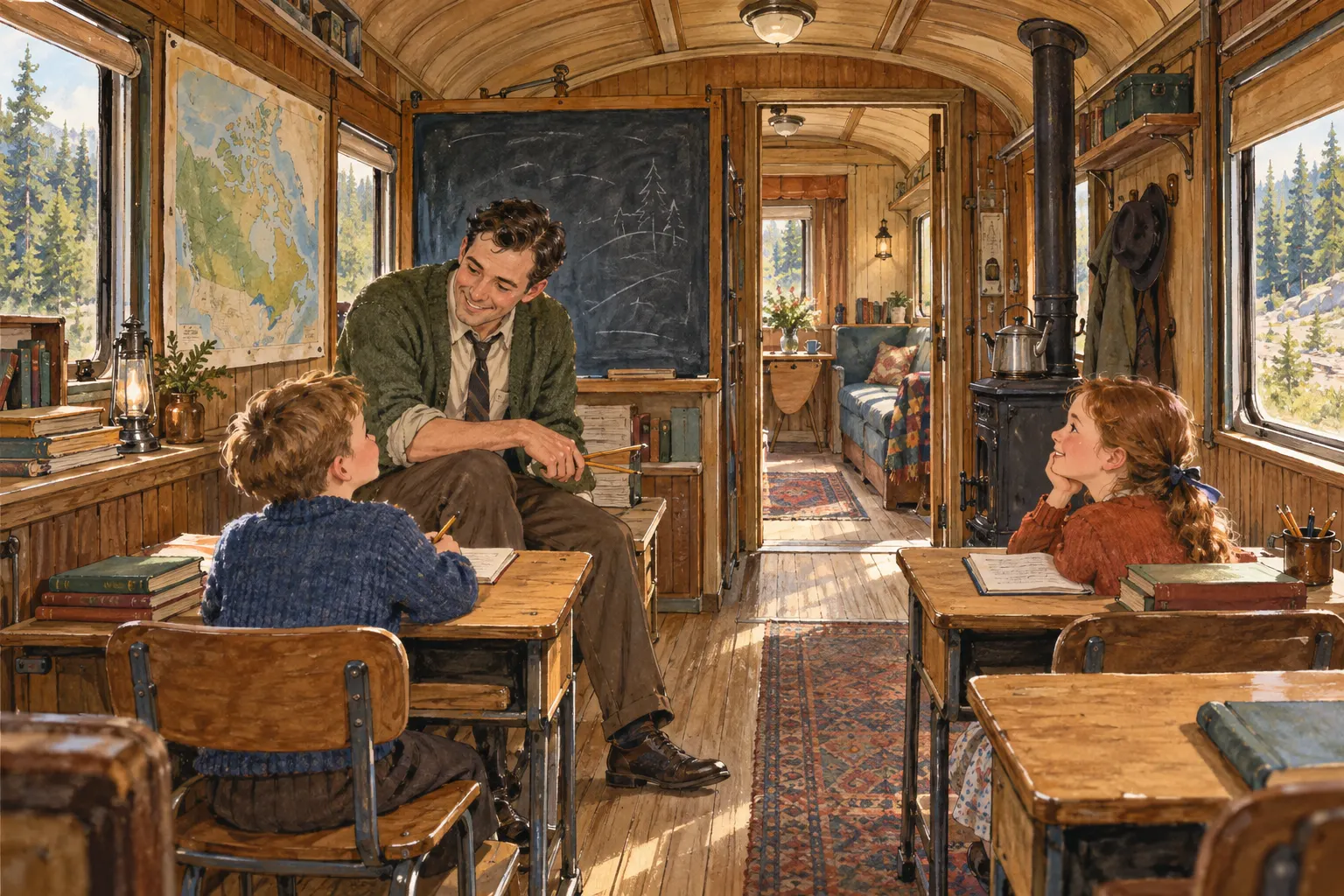
From 1926 to 1967, the Canadian National Railway hauled schools along the line in northern Ontario. There were seven school cars. The one taught by Fred Sloman worked the 240 kilometres between Capreol and Foleyet, stopping at a siding for a week, teaching any number of children of any age, then moving on and leaving homework to be finished before it came back, about a month later.
The school leaves on Monday. The homework does not.
Some pupils, the museum that now keeps the car explains, traveled many miles by canoe, dog team or snowshoe for that week of class. They were the children of railway section workers, many of them newly arrived immigrants, as well as woodsmen, hunters, trappers and Indigenous families.
I drive the middle one eleven minutes to school and he describes it to his friends as a commute.
The car was a classroom in front and a home in back. LIFE photographed it in 1954. The back section, 28 feet long, housed seven people: Fred, who taught on the line for 39 years, his wife Cela, and their five children. The car was nine feet wide and had no running water. On arriving at each new stop, the family went straight to the nearest river to fetch water. The dining table folded up into the wall like a Murphy bed. The parents slept on a fold-out sofa. The children slept in bunks.
Their daughter, who was fifteen in the LIFE photographs, told the magazine in 2021 that it seemed normal, since it was all she knew, and that the best part was the afternoons, when the other children went home to chores and she went off alone into the bush to study animal tracks and collect wildflowers. "It was a perfect childhood," she said, and then added: "Though I don't know any other kid that would have thought it was the perfect childhood."
That is the most precise review of a childhood I have ever heard. My own children would give theirs four stars, with a note about the Wi-Fi.
One former pupil, who arrived from Italy in the early 1950s at a little over six without a word of English, wrote that it was "truly a blessing to have the Slomans as our mentors, friends and extended family."
The Slomans retired in 1965. The car, damaged by fire and vandalism, was found by the family years later and bought by the town of Clinton, Ontario, where it was restored and now sits as a museum in Sloman Memorial Park.
We once lived in two rooms for six weeks during a kitchen renovation, with a microwave on the dresser. We considered it a hardship and told everyone. The Slomans did it for thirty-nine years, with a classroom attached, and a river for the dishes.
Sources
The public records, school pages and published accounts this story draws on. Where the story imagines a scene or a line of dialogue, that is the column’s telling, not a quotation.
- Bill Syken, LIFE: Canada’s School on Wheels, a Teacher’s Daughter Remembers (2021), with Cornell Capa’s 1954 photographs life.com
- School on Wheels Railcar Museum: The School Car schoolcar.ca
- Municipality of Central Huron: CNR School on Wheels Museum centralhuron.ca