School rivalries / 1893–1896
Exeter's Star Halfback Was 27 and Had Raced Horses
In 1893 Exeter beat Andover with a schoolboy who had worked for Barnum and Bailey. Andover was outraged, and then, much later, honest.
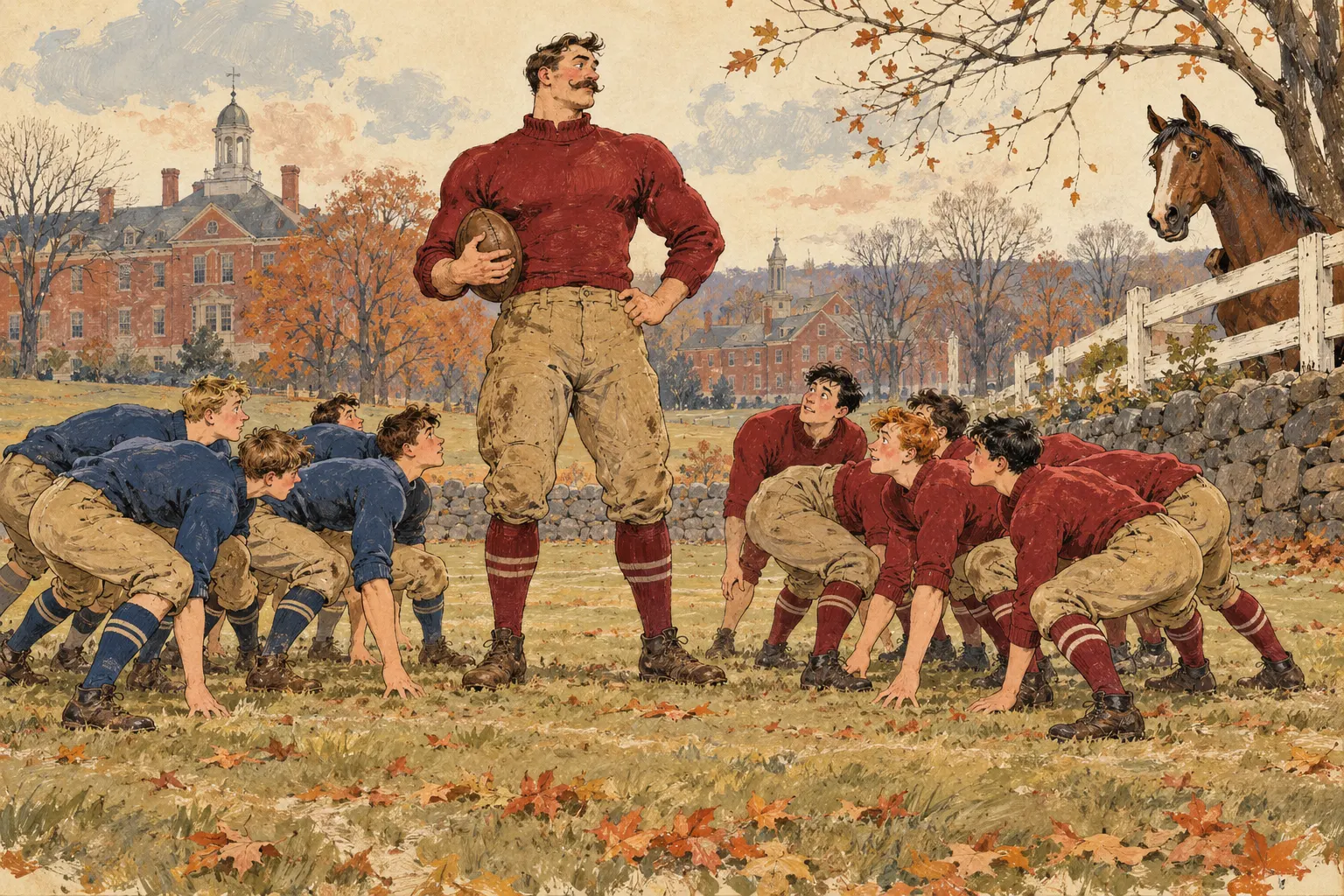
In November 1893 Exeter beat Andover 26–10 in front of five thousand people, and the star of the game was a halfback named William "Pooch" Donovan. He was twenty-seven. He had performed in man-versus-horse races for the Barnum and Bailey Circus. Just before enrolling at Exeter, he had been coaching track at Worcester Academy.
I coach the youngest's under-eight soccer team, and last fall another team turned up with a boy who was nine and a half. I have not stopped talking about it. Exeter had a grown man who had raced horses.
Days after the game, the Boston Herald revealed that Donovan and two teammates had enrolled late that fall and left soon after the final whistle. The Andover student body voted unanimously to suspend all competition with Exeter. "A BOMBSHELL!" said the Boston Journal. Exeter's reply ran in the next day's Globe, under the headline "Exeter is Amused." The consensus in New Hampshire was that Andover had known all along and was acting like a "cry baby."
Then the grown-ups arrived. Theodore Roosevelt weighed in. In February 1894, 180 Andover alumni held a dinner at the Hotel Vendome in Boston that turned into a rally against professionalism, with a governor, the president of Harvard and Andover's principal, Cecil Bancroft, all speaking against it. Bancroft assured the room that every member of the Andover eleven was fully enrolled, "or were when I left this morning."
There were no games for three years. Andover made Lawrenceville its chief rival, which meant trains between Massachusetts and New Jersey and almost nobody watching. Yale and Harvard, worried about their supply of football players, started writing editorials asking everyone to make up.
They did, in November 1896. Exeter came to Andover slightly favored. Harper's Round Table reported that Exeter's confidence "soon became akin to demoralization," praised the officials for the clean play, and recorded the score: Andover 28, Exeter 0. Everyone behaved beautifully, and Andover scored twenty-eight points while doing it.
And then, after the reunion game, Andover's student literary magazine published an editorial with a confession in it. Andover had understood the situation clearly beforehand. Instead of being ignorant that it would meet professionals, the Mirror admitted, Andover had "sought glory in the hope of defeating them."
Three years of moral outrage, a governor, a dinner, a future president, and the whole time the plan had been to beat the circus.
Donovan, for his part, did fine. According to his 1928 New York Times obituary, he played for Exeter against Andover one Saturday and starred for Georgetown the next, and later spent twenty years as an athletic trainer at Harvard.
The boy who was nine and a half, I should say, scored four goals against us. I protested to the league. The league asked whether I had read his birth certificate before the game, and I had to admit that I had. I was hoping to beat him.
Sources
The public records, school pages and published accounts this story draws on. Where the story imagines a scene or a line of dialogue, that is the column’s telling, not a quotation.
- Phillips Academy: “Pride, professionals and a man named ‘Pooch’” andover.edu
- Phillips Exeter: “E/A: The anatomy of a rivalry” exeter.edu
- The Phillipian: “Andover/Exeter Rivalry Continues in 142nd Year” (2019) phillipian.net
- Harper’s Round Table: Interscholastic Sport, November 17, 1896, p. 65 gutenberg.org
- Harper’s Round Table: Interscholastic Sport, November 24, 1896, pp. 97–98 gutenberg.org