School life / A FIRST Tech Challenge weekend in Iowa City, February 2015
An Airline Lost Their Robot. Iowa Teams Lent Them Parts.
In 2015 a middle school team flew from Shenzhen to compete in Iowa City. The robot did not arrive. The teams they had come to beat did.
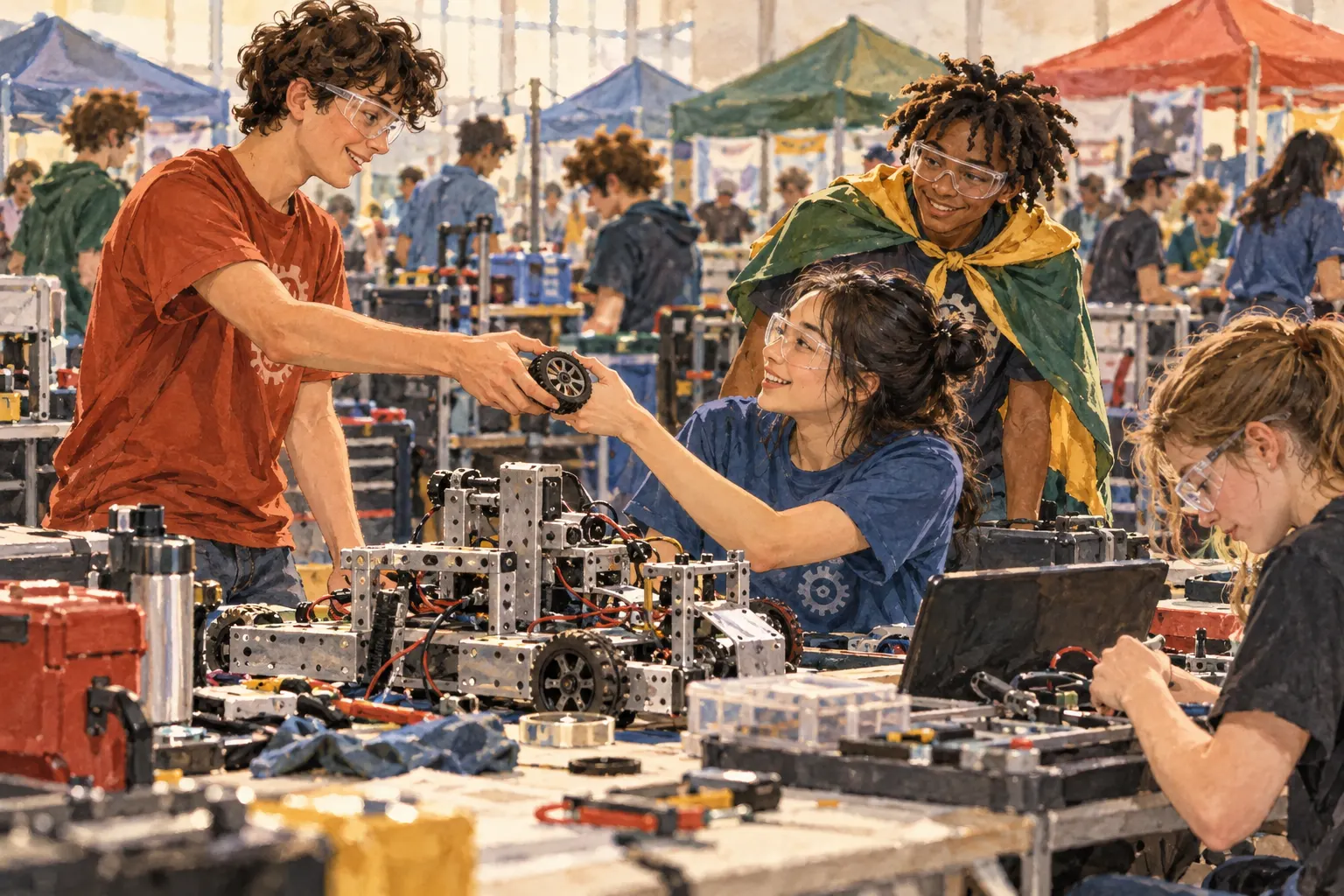
On a Friday in February 2015, a robotics team from Shenzhen Middle School in China landed in Chicago on its way to a FIRST Tech Challenge competition at Regina High School in Iowa City, scheduled for the next morning. The airline had lost the robot.
A robotics team without a robot is not a team. It is a group of teenagers with laptops and nothing to plug them into.
Students from Solon, Iowa, offered their spare robot, KCRG reported. Then other teams joined in. "Some teams gave us some other materials, in total four teams helped us," a fourteen-year-old on the Shenzhen team told the station. It was, he said, a spirit of helping each other.
They programmed through the night. When they checked in at seven on Saturday morning, the local event partner said, they had built "a mini version of the robot that was lost."
I have built one thing overnight in my life, a bookcase from a flat-pack box, and at seven in the morning it was a mini version of a bookcase, leaning, with four screws left over.
The Shenzhen team won the design award, which qualified them for another Iowa competition the next month. They were completely thrilled, the event partner said. And on Tuesday the airline called. It had found the original robot.
The robot that won the design award was made of rivals.
There is a word for this in robotics, which an educator heard at a FIRST tournament in California the following year: "coöpertition." Alliances shift through the day, so the robot you play against in the morning may be your partner in the afternoon, and it is in everybody's interest that it works. That educator also noted the costumes: gladiators, "Pi-rates," a team dressed as Egyptian pharaohs, and "more capes than a San Dieguito lunchtime."
Berkeley High's robotics team wrote recently that the habit runs deep. When a competition robot breaks at an event, you can't throw it away; you fix it, fast. They took that habit to a district Fix-it Fest in October 2025 and helped repair around twenty broken items, from kitchen appliances to electronics. The most important thing robotics had taught them, they wrote: "stuff is fixable."
Stuff is fixable. My garage disagrees. It contains a printer, two lamps and a robot vacuum that I have described for three years as "temporarily" not working.
I took the vacuum to a repair café last month, with the middle one, who has started robotics. A teenager in safety goggles opened it, removed a sock, and handed it back. I offered to pay. He said it was coöpertition. The middle one has not let me forget it, and has asked whether we can lend our printer to someone who needs it more.
Sources
The public records, school pages and published accounts this story draws on. Where the story imagines a scene or a line of dialogue, that is the column’s telling, not a quotation.
- KCRG report republished by University of Iowa Engineering, February 25, 2015 engineering.uiowa.edu
- Bjorn Paige, Mr. Roboto, March 11, 2016 bjornpaige.wordpress.com
- Hazel Lutzker and Anna Williams, Berkeley High School Robotics Team, February 8, 2026 cultureofrepair.org