School life / Moon Trees, 1971–2026
The Moon Tree Was Found by Third Graders
In 1971 an astronaut carried tree seeds around the Moon. Nobody kept track of where the trees went. In the 1990s, an Indiana class went looking for one.
In February 1971, Stuart Roosa, command module pilot of Apollo 14 and a former forestry smoke jumper, carried a canister of several hundred tree seeds in his personal kit. They circled the Moon with him while his two crewmates walked on it. Back on Earth, the Forest Service germinated them, and for the 1976 Bicentennial the seedlings went out to schools, state capitals, the White House and elsewhere. The records of where they went disappeared.
A seed can go around the Moon and back and still be lost in the paperwork.
In the late 1990s, Joan Goble's third graders at Cannelton Elementary in Indiana were choosing a tree to research for an online project. A student who was a Girl Scout mentioned a tree with an odd sign at the local Girl Scout camp. It was a Moon Tree, she said. She didn't know what that meant.
They chose it. The school secretary's father had directed the camp, and he knew the tree had come in 1976 for the Bicentennial, but not why it was called a Moon Tree. The class searched NASA's Apollo archives. Nothing. So they emailed Dave Williams, a planetary scientist at NASA's Goddard Space Flight Center. He didn't know either. He said he would find out, and within days he had asked around Goddard and found the answer: Roosa.
His curiosity was up, Goble wrote, and he started a web page to track down every Moon Tree he could. He had found fifty when she wrote about it.
So a third-grade research project helped start the list. The class asked a question that NASA's own scientist couldn't answer, and he was curious enough to go and find out.
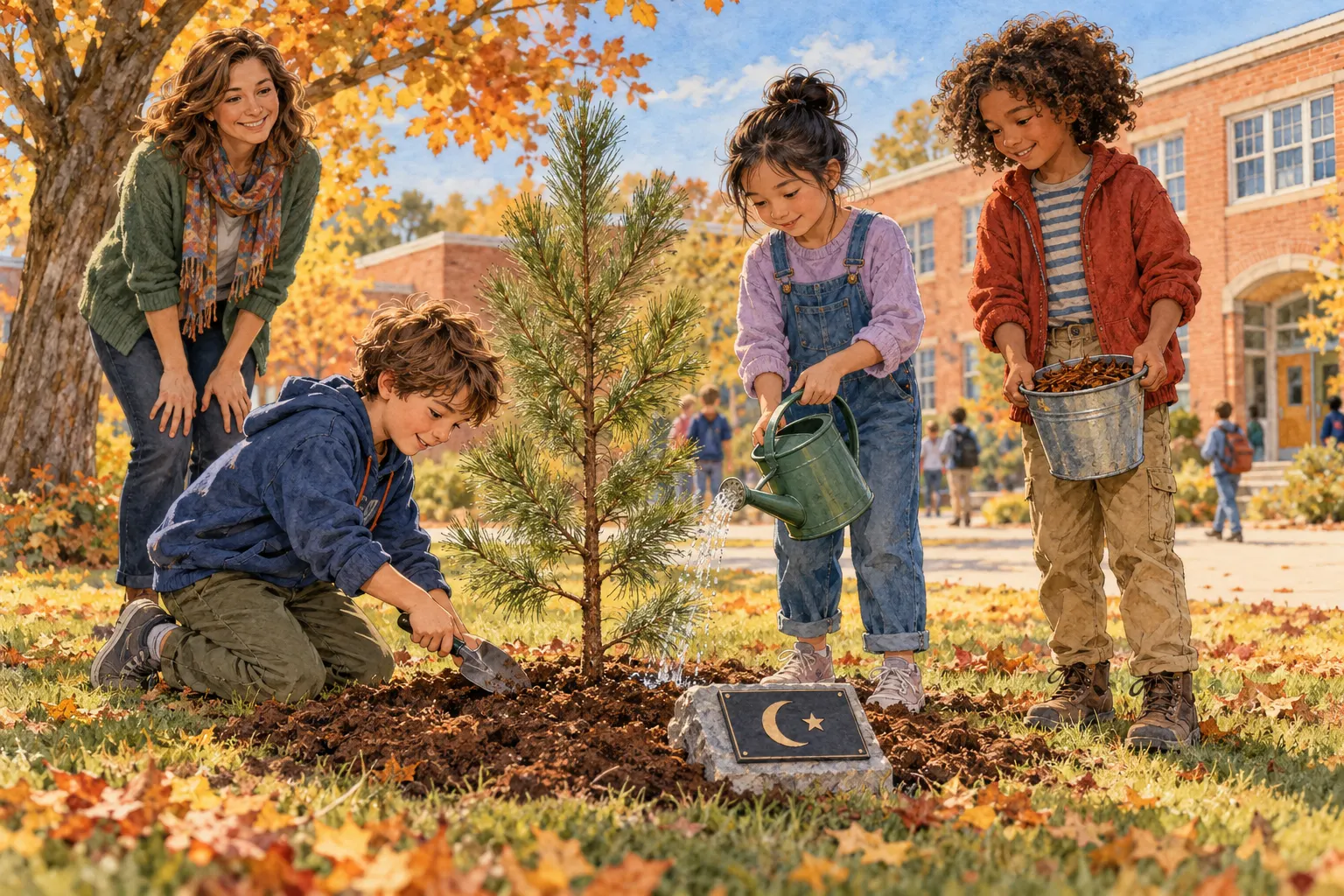
The idea came back. Seeds flew around the Moon on Artemis I in 2022. In Hampton, Virginia, third through fifth graders at Mary W. Jackson Elementary School planted one, a loblolly pine, in November 2025, working in teams called Earth Excavators, Compost Crew, Mulch Movers and Water Brigade. It was dedicated in March 2026.
The Water Brigade has the longest job. A seed can go around the Moon and back and still need someone with a watering can.
We have a maple in the front yard that has been nowhere. The youngest has decided it is a Moon Tree anyway, on the grounds that the moon is directly over it most nights. She has made it a sign. I have not had the heart to check with NASA.
Sources
The public records, school pages and published accounts this story draws on. Where the story imagines a scene or a line of dialogue, that is the column’s telling, not a quotation.
- NASA History: Moon Trees nasa.gov
- Joan Goble, Project Moon Tree techlearning.com
- NASA Science: Artemis Moon Tree Dedicated in Honor of Mary W. Jackson science.nasa.gov