School stories / Found in 2009 · Brought home in 2010
A Webb Graduate Found a Dinosaur Two Days Before Going Home
In 2009 a Webb Schools fossil expedition in Utah crossed ground the professionals had already searched. A teenager looked under a rock anyway.
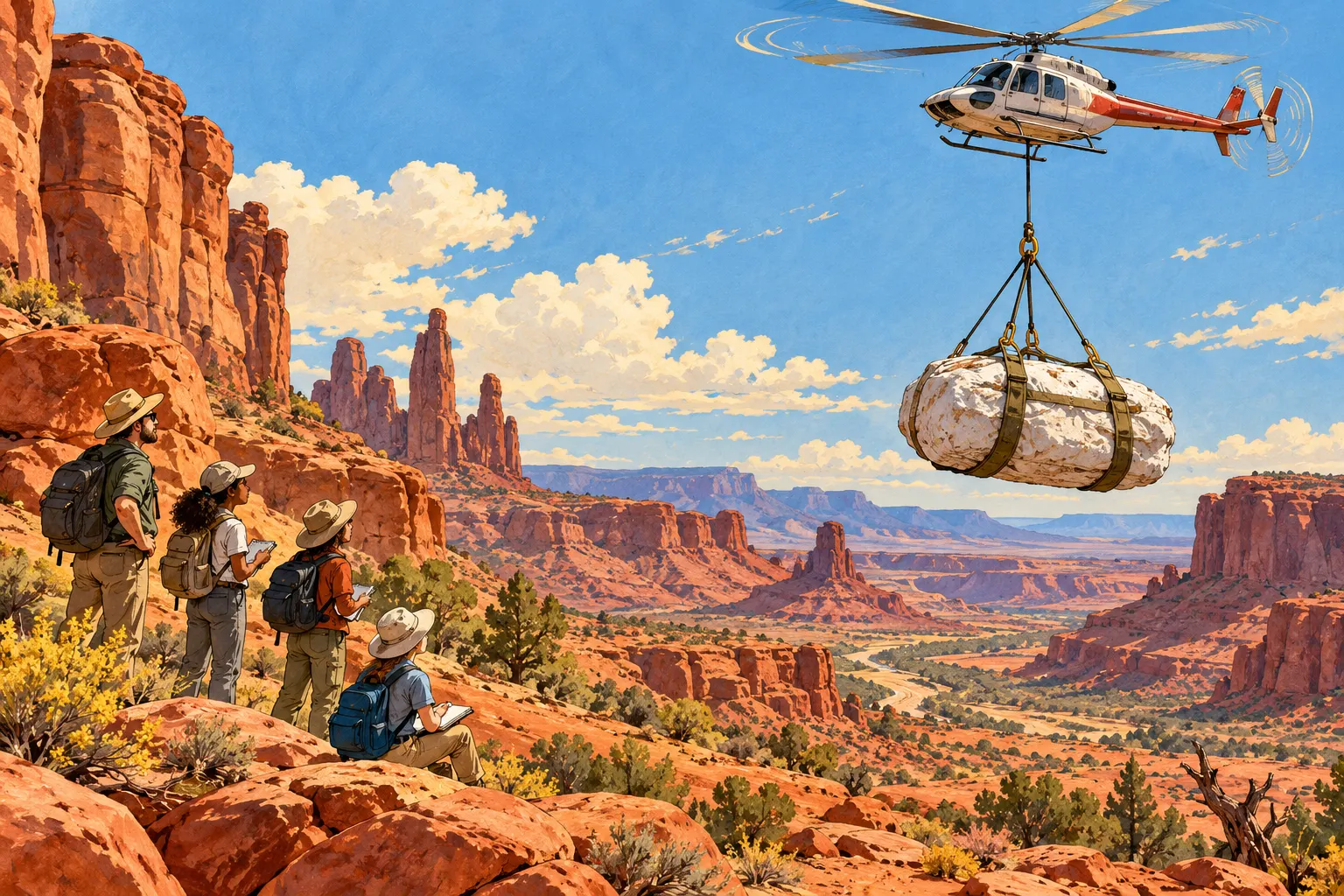
In August 2009 a field party from the Raymond M. Alf Museum of Paleontology, which sits on the campus of The Webb Schools in Claremont, California, was prospecting in Grand Staircase-Escalante National Monument in southern Utah. Three students and the paleontologist Andy Farke were hiking quickly through an area that had already been searched that year and in years before, heading for unexplored rock.
One of the students, who had just graduated and was seventeen, glanced under a hoodoo, a mushroom-shaped rock, and saw bone. Farke looked, and dismissed it: a piece of dinosaur rib, common, of little scientific value, and a lot of work to dig out.
Then, as the museum's own account puts it, Farke walked to the other side of the hoodoo, on a whim, and turned over a small cobble. "Staring up at him was a dinosaur skull. This was rather unexpected."
"This was rather unexpected." That is a museum describing a paleontologist finding a dinosaur looking back at him. I use more adjectives when a parking space opens up.
"We kind of jumped up and down," Farke later told the Salt Lake Tribune. The rib turned out to be a string of toe bones. With a skull at one end and toes at the other, there had to be a skeleton in between.
The trip was leaving in two days. They didn't have the time or tools for a full excavation, and their permit covered fossils exposed on the surface, so they removed the bones in danger of erosion and left the rest. The dinosaur would have to wait a year.
It did. In 2010 a Webb crew came back with jackhammers, wrapped the bones in plaster-soaked burlap against the vibration, trimmed down the rock, added a thicker plaster jacket, and, because the site was steep, treacherous and miles from a road, sent the block out in a cargo net under a helicopter.
The skeleton, nicknamed Joe, turned out to be the youngest, smallest and most complete Parasaurolophus yet known, less than a year old, with the start of a crest already on its head. It took more than 1,270 hours to clean. Farke, the man who had called it a rib, rated it: "On a scale of 1 to 10, this one is an 11."
Four years after the find, the discoverer, by then studying paleontology in college, told the Claremont Courier that he still had plaster stuck in his hiking boots.
Our family's best field find was a rock shaped like Ohio, on a beach in 2019. Nobody called it a rib. Nobody called it anything. It is in a drawer. I have not needed a helicopter, but I have needed my wife to stop asking why we kept it.
Sources
The public records, school pages and published accounts this story draws on. Where the story imagines a scene or a line of dialogue, that is the column’s telling, not a quotation.
- Alf Museum: Joe the Dinosaur — Discovery (archived May 2014) web.archive.org
- Claremont Courier: Teen makes remarkable dinosaur find (November 4, 2013) claremontcourier.com
- The Salt Lake Tribune: Then-high schooler credited with historic Utah dinosaur find (October 23, 2013) archive.sltrib.com
- Alf Museum announcement: High School Student Discovers Skeleton of Baby Dinosaur prnewswire.com
- Farke et al. (2013): Ontogeny in the tube-crested dinosaur Parasaurolophus and heterochrony in hadrosaurids pmc.ncbi.nlm.nih.gov
- The Webb Schools: History of the Alf Museum webb.org