School life / One spring musical, Delmar, New York, 2007
The Parent Clapping for the Scene Change
In 2008 a Delmar, New York, mother wrote about watching her sixth grader work on running crew and lights. Her proudest moment was a figure in black, carrying a bench across a dark stage.
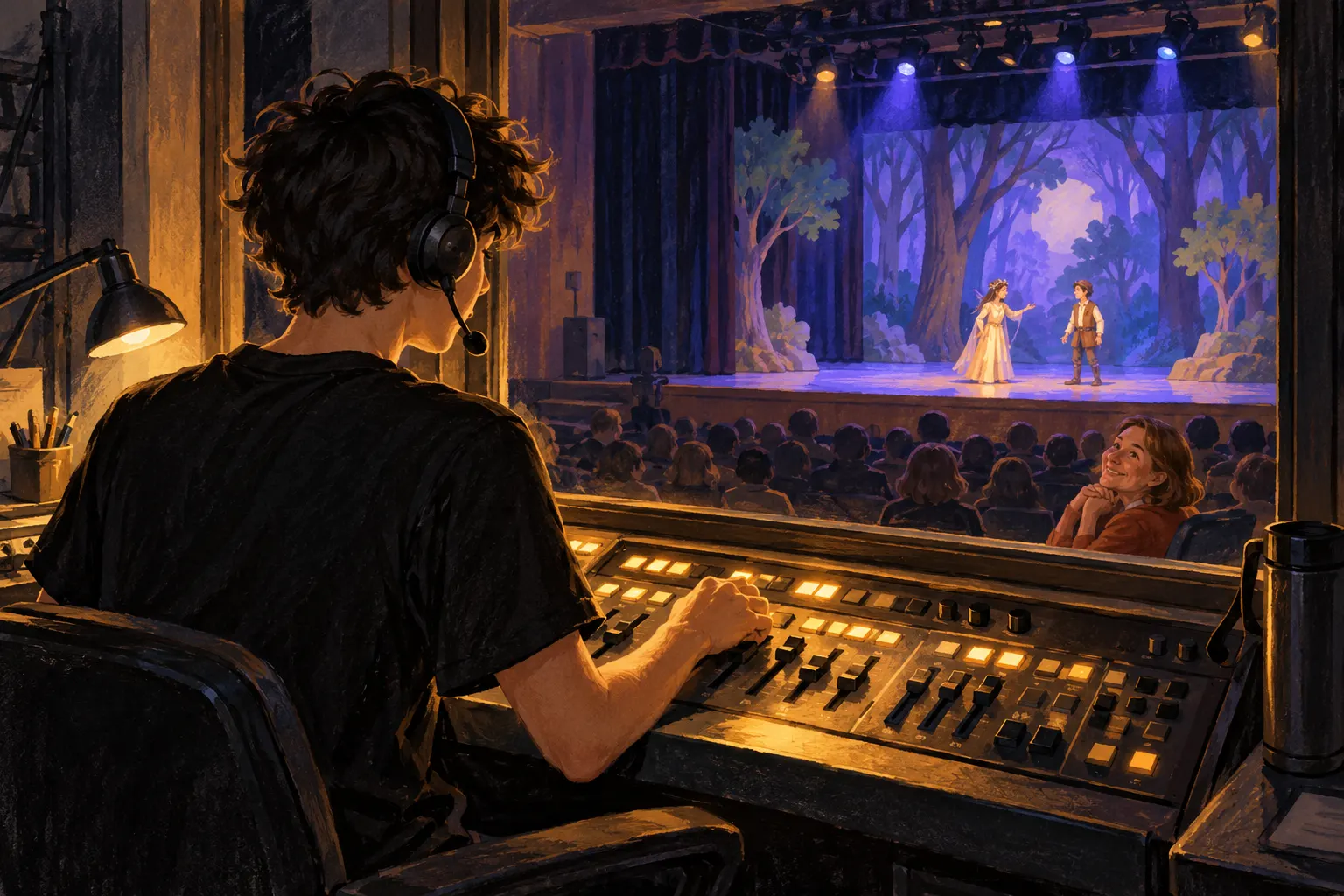
In March 2008, Robin Shrager Suitor wrote a column for The Spotlight, her local paper in Delmar, New York, about her daughter's year in middle school theater. The daughter, a sixth grader, did not want to audition. She joined the technical crew instead.
Running crew, her mother learned, are the people who run on and off the stage in the dark, changing scenery and props. It involves short bursts of running and a lot of waiting, and they have to attend every rehearsal to know when and where to run.
At the musical she sat in the audience and caught a glimpse of her daughter, dressed completely in black, dashing across the dark stage to position a piece of scenery. She whispered to her husband that it was her daughter who had just brought the bench on. On the third night, the student who worked the curtains was out sick, and her daughter said yes to handling them too.
Most parents at the school play are watching their child. The crew parent is watching the dark.
Then, before the musical had even ended, her daughter announced she had joined the lights and sound crew for the next production, a student-directed The Lion, the Witch and the Wardrobe. Two shows at once was, her mother wrote, pure insanity. During that play she could not see her daughter at all, but she knew she was just to the side of the curtains, working the stage lights. "Wait for the thunder and lightning scene," she whispered to her husband.
Crew work can carry a whole show. In 2024, a student journalist in Philadelphia profiled a senior who was the one and only stage manager at her performing arts high school, overseeing 55 student volunteers. Once, moments before a showcase's second act, the actors' microphones failed. She sent the deck crew for handheld microphones, and the show went on.
At a Toronto school in 2026, two grade 11 stage managers told their school paper about the master binder for their production of Clue, with more than 200 cues.
The middle one ran the light board for his school's spring play. There was one cue he worried about all week, a slow fade at the end. On the night, I did not watch the actors once. I watched the fade. It was perfect. I started clapping in the dark, before the lights came back up.
In the car he asked if that was me. I said I didn't know. He said please don't do it tomorrow. I did it tomorrow.
Sources
The public records, school pages and published accounts this story draws on. Where the story imagines a scene or a line of dialogue, that is the column’s telling, not a quotation.
- Robin Shrager Suitor, School plays set the stage for winners, The Spotlight, March 19, 2008, page 4 webapps.bethlehempubliclibrary.org
- Shenaire Chandler, A high school student's hectic life as the stage manager, Acel Moore High School Journalism Workshop, March 15, 2024 acel-moore.com
- Michelle Olatunji, The Flight Backstage, Behind the Ivy, February 23, 2026 behindtheivyhc.com