School traditions / St Andrew’s Day, one November
Eton's Wall Game Has Not Produced a Goal Since 1909
The St Andrew's Day match is played against a wall built in 1717, with a door and a tree for goals. The college archives explain the rules, and a schoolboy's diary from 1866 explains the shins.
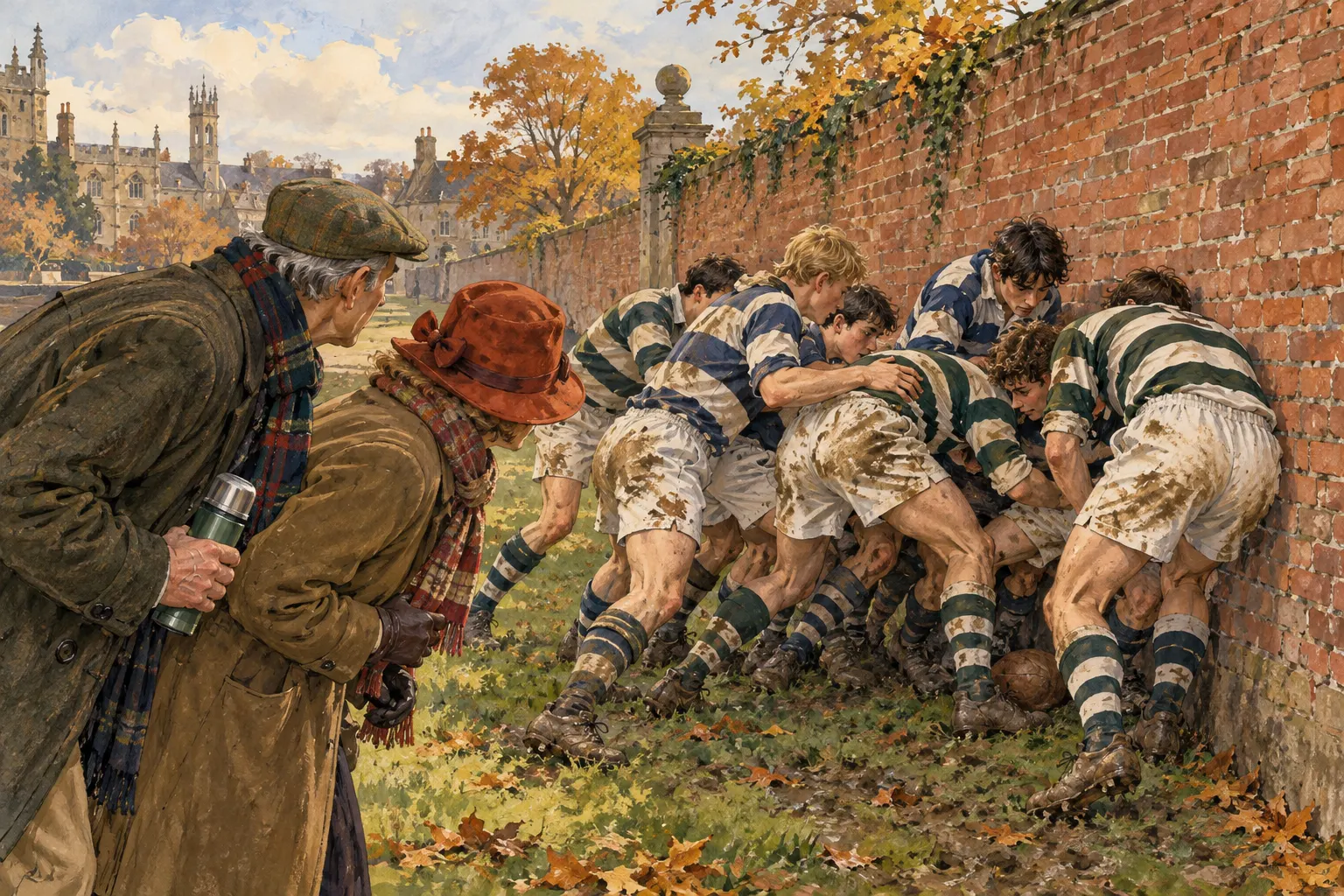
Nobody knows when Eton first played the Wall Game. The college's archives say there are references to something like it in the 1750s, and the first written rules date from 1849. What they can say is that the wall itself was ordered built on January 14, 1717, along the edge of the Playing Fields, so the game cannot be older than that.
It is played on a strip about five meters wide beside the wall. Ten players a side. One goal is a door in an adjacent wall; the other is a tree. Each side tries to stop the other moving the ball, and the result, the archive says plainly, is a static scrum.
Points come mostly from shies. A shy, worth one point, is scored at the opponents' end, in an area called calx, by lifting the ball against the wall with your foot. The scoring side then gets to throw the ball at a target, a door in the wall, worth nine more.
The main match of the year is on St Andrew's Day, between the Collegers, the King's Scholars, and the Oppidans, everyone else. According to the college, no goal has been scored in that match since 1909. You can still win on shies.
A sport whose big annual match has not produced a goal since 1909 is a sport that has made its peace with process.
On November 30, 1866, an Oppidan named C.H.H. Parry wrote it up in his diary. He was "in an awful funk all the night." The Oppidans had breakfast together and went down to the ground expecting to lose. He kicked the ball into calx. They claimed two shies; both were disallowed. He got, in his own phrase, tremendously shinned, and came away, as he put it, "in a wounded condition." The match was a draw. Then there were songs and speeches at an inn, players were hoisted through the dusk while all Eton ran and shouted, and he went to bed tired out.
Nerves all night, two disallowed shies, a shin, a draw, a party. That is not a bad day.
The mud is part of it. The archive quotes a former student writing from the trenches in 1915, comparing the mud there to the stuff found under the wall after St Andrew's Day.
We have a fence in the backyard and a maple. The middle one has proposed a Wall Game. He would be the Oppidans. The youngest would be the Collegers. The ball would be a soccer ball. The goals would be the gate and the tree.
They played for forty minutes last Sunday. Nobody scored. The middle one claimed two shies. Both were disallowed, by the youngest, who was also the referee.
Sources
The public records, school pages and published accounts this story draws on. Where the story imagines a scene or a line of dialogue, that is the column’s telling, not a quotation.
- Eton College Collections: Origins of the Wall Game collections.etoncollege.com
- Eton College Collections: Logie Leggatt and the annual St Andrew’s match collections.etoncollege.com
- Eton College Collections: St Andrew’s Day at Eton College collections.etoncollege.com