School portraits / Monday afternoons, a first year of chess club
At Trinity's Chess Club, Checkmate Ends With Twirled Mustaches
Chess Life visited a Manhattan school's Monday beginners' group in 2025. The coach taught a pin, and then the villain's laugh to go with it.
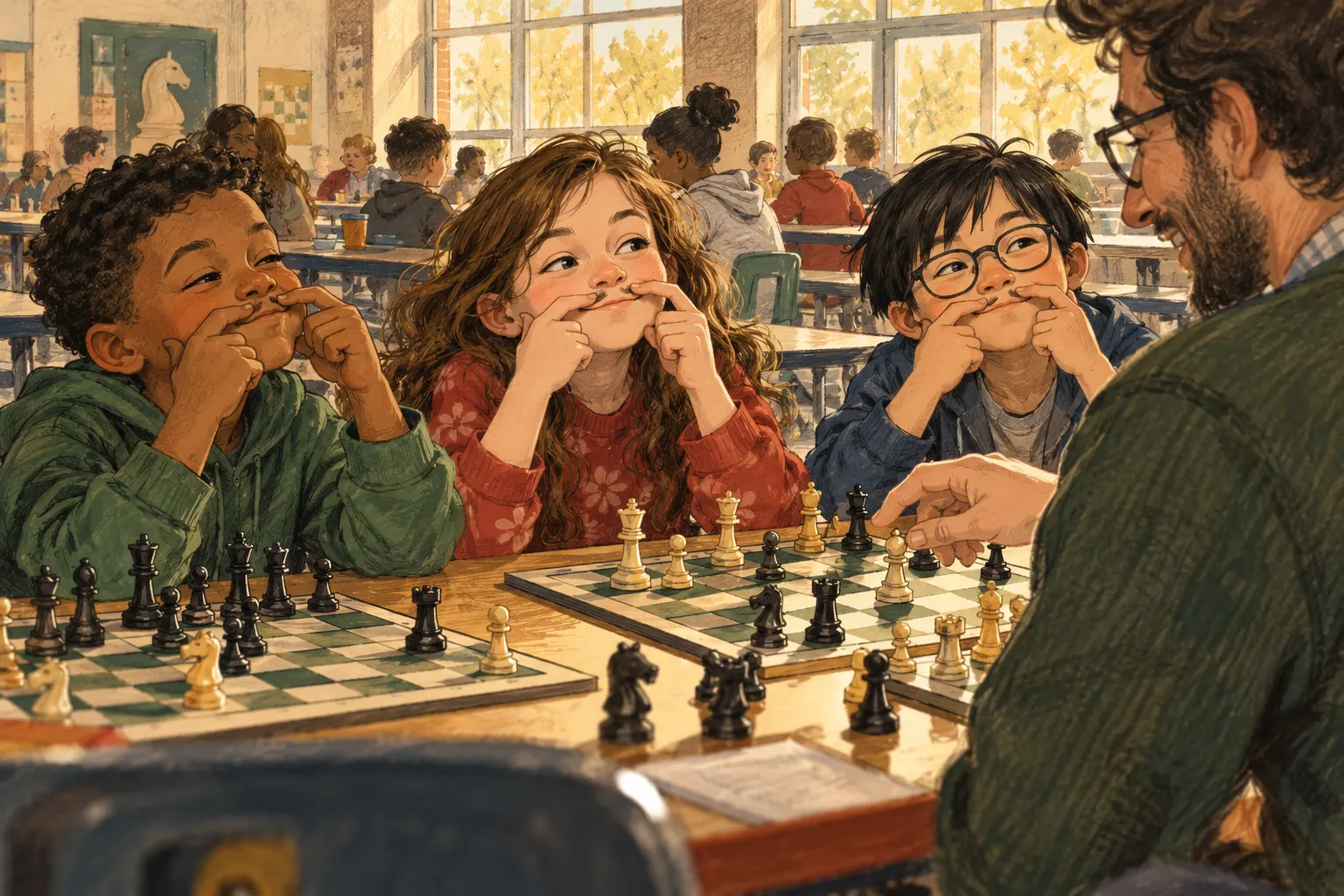
"De-fense!" shouted about a dozen small voices, as Chess Life's reporter arrived at Trinity School on Manhattan's Upper West Side on a Monday afternoon in 2025. The cafeteria hosts the beginners' chess group, mostly five- and six-year-olds, many of whom had only just learned how all the pieces move.
The coach, Jonathan Corbblah, forty-five, has taught chess in New York City schools for more than twenty years. The magazine noted his fuzzy sweater, his Timberland boots, his "zany catchphrases," and the M&Ms he frequently hands out as prizes, and concluded that he doesn't so much control the chaos of a room full of small children as ride the wave.
I have tried to control a room full of five- and six-year-olds, at a birthday party. I did not ride the wave. The wave rode me, into the coat closet, where I hid with the cake.
Then a voice called out across the cafeteria: a young player had made a checkmate. Everyone gathered around the board, and the coach walked them through it: the opponent's king pinned between a bishop at one end of the board and a queen at the other.
And then he added the most important part of the lesson. "Now twist your mustaches," he said, and gave a loud, devious laugh. The children, who had no mustaches, twirled them anyway, trying to imitate his chortle. "You see," he told them, "chess players must be sneaky."
A whole cafeteria of kindergartners twirling imaginary mustaches is the best argument for chess I have ever heard. The game teaches patience, planning and pattern recognition. It also, crucially, teaches the laugh.
Then it was back to the boards, and later a worksheet. The reporter asked a kindergartner with a mop of curly hair whether he had just learned to play this year. "No; I learned in Pre-K," he said, and went back to his "Mate in 1" worksheet, his name written across the top in letters still uncertainly formed.
"No; I learned in Pre-K." He said it the way a veteran says he was at Normandy.
Trinity's after-school program runs chess at several levels, up to a championship class requiring tournament experience and a rating of 1000 or more.
The youngest plays chess now, badly, with enormous confidence. Last night she pinned my king between her bishop and her queen. I did not notice. She twirled an imaginary mustache, laughed a long devious laugh, and asked for an M&M. I paid her two.
Sources
The public records, school pages and published accounts this story draws on. Where the story imagines a scene or a line of dialogue, that is the column’s telling, not a quotation.
- Jack Moore: The New York School, Chess Life, July2025, printed page34 new.uschess.org
- Niche: Trinity School New York reviews niche.com
- Trinity: After School offerings trinityschoolnyc.org